Tuesday, December 30, 2003
Yah.
That was the most dumb-assed thing I've ever done, and I'm not even going to write about it because then everyone will send me e-mail saying, "Susan, that is the most dumb-assed thing you've ever done." And they'd mean it.

Reading.
Did I say I don't like short stories? What I meant to say was, "I don't like short stories that aren't written by Flannery O'Connor."
Faith-based Prison
When I was over at Talk Left: The Politics of Crime today, I came across a short discussion of Jeb Bush's faith-based prison initiative. There's a more in-depth discussion at Punishment Theory, but you'll probably have to wade through the entry at Legal Theory, too, if you want to make sense of it.
Monday, December 29, 2003
Stories I Stole.
I realize I was predisposed to like Wendell Steavenson's book. Sometimes when I'm reading, I remind myself of Will Farrell in Elf: "Santa!!! I *KNOW* him!!" I get so excited that someone else has shared my life experiences that I forget to look for anything else in the text. So, when Ms. Steavenson opened up her book with a description of her visit to the private Stalin shrine outside of Tbilisi, I was hooked.
The first time I was in the Soviet Union, going to school at LGU, we took a late summer tour to the Ukraine and Soviet Georgia. I hated Georgia for reasons that don't need to be described here, but it was also the place of the most unforgettable--and afterward indescribable--events of the entire summer. And most indescribable was our unscheduled visit to the house of one Temuri (Timor) Kunelauri. Mr. Kunelauri had turned his home into a monument to the life and career of Stalin. Actually, it wasn't just his home, it was his yard, as well. The yard was fenced, but the fence was covered so densely with vines you'd never know there was even a support system underneath. The vines also stretched overhead, turning the garden into something of an interior space--very Mediterranean. Mixed in with the vines was all the Stalin memorabilia you could ever hope to find--statues, photos, paintings... I'm about to break copyright law and post some photos below, because really, I can't describe it.
Stalinist Georgia really defies description, at least by me. I was there still during the Cold War--Stalin had fallen out of favor throughout the USSR, his monument removed from the Kremlin walls in Moscow, cities had changed their names back from Stalingrad, Stalin Village, etc. to still-Soviet-but-less-Stalinesque names. Then you find yourself in Stalin's homeland, and you forget what a sly little man he really was. It wasn't even that people were whispering about him admiringly behind their hands. It was more like, "Hey, that Dzhugashvili kid! Home town boy made good!"
Okay, I'm reading this, and thinking, so what? It's definitely one of those "you had to be there" kind of things. And that's probably why I'm liking Stories I Stole, because they do a better job of making you feel like you were there than I ever could. I also just like the concept of stealing stories, since that's what my anecdotes about my two summers in the Soviet Union still feel like. I take bits and pieces of the lives of the people still living there and turn them into narratives to entertain my friends. Some of my stories--like the one about getting treated (or not) for bronchitis--still bring people to an astounded halt. Others--like the one about hitchhiking back to our hotel in Tbilisi w/a police office--make no impression on anyone who has not dealt with Soviet law enforcement techniques. Wendell Steavenson could probably do a better job of telling both tales.


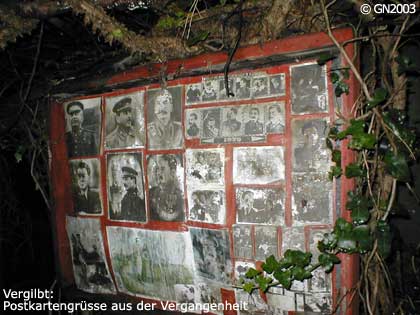
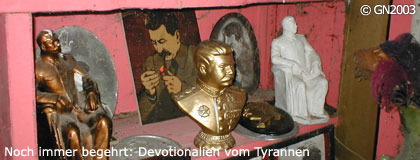
The first time I was in the Soviet Union, going to school at LGU, we took a late summer tour to the Ukraine and Soviet Georgia. I hated Georgia for reasons that don't need to be described here, but it was also the place of the most unforgettable--and afterward indescribable--events of the entire summer. And most indescribable was our unscheduled visit to the house of one Temuri (Timor) Kunelauri. Mr. Kunelauri had turned his home into a monument to the life and career of Stalin. Actually, it wasn't just his home, it was his yard, as well. The yard was fenced, but the fence was covered so densely with vines you'd never know there was even a support system underneath. The vines also stretched overhead, turning the garden into something of an interior space--very Mediterranean. Mixed in with the vines was all the Stalin memorabilia you could ever hope to find--statues, photos, paintings... I'm about to break copyright law and post some photos below, because really, I can't describe it.
Stalinist Georgia really defies description, at least by me. I was there still during the Cold War--Stalin had fallen out of favor throughout the USSR, his monument removed from the Kremlin walls in Moscow, cities had changed their names back from Stalingrad, Stalin Village, etc. to still-Soviet-but-less-Stalinesque names. Then you find yourself in Stalin's homeland, and you forget what a sly little man he really was. It wasn't even that people were whispering about him admiringly behind their hands. It was more like, "Hey, that Dzhugashvili kid! Home town boy made good!"
Okay, I'm reading this, and thinking, so what? It's definitely one of those "you had to be there" kind of things. And that's probably why I'm liking Stories I Stole, because they do a better job of making you feel like you were there than I ever could. I also just like the concept of stealing stories, since that's what my anecdotes about my two summers in the Soviet Union still feel like. I take bits and pieces of the lives of the people still living there and turn them into narratives to entertain my friends. Some of my stories--like the one about getting treated (or not) for bronchitis--still bring people to an astounded halt. Others--like the one about hitchhiking back to our hotel in Tbilisi w/a police office--make no impression on anyone who has not dealt with Soviet law enforcement techniques. Wendell Steavenson could probably do a better job of telling both tales.
Sunday, December 28, 2003
More reading.
That's right. I forgot. I don't like historical fiction, and Alice in Exile is reminding me why. If an author knows her (or his, in this case) history, and keeps the book true to it, it can turn into an all too predictable read for another historian. I don't need to read a ficitious story about pre-Great War landed gentry because I already know too much about them already, and I can pretty much guess what a character who hopes to be returned as the Conseravtive MP from Knapley is going to do. Then again, if the author strays from written history and has a character making original or novel decisions, then it turns into an exercise in exasperation for the readers, because they know no real person could have behaved that way in that place and time. So, a choice between tedium and disbelief--not a good place for me to be as a reader.
It's not that it's a poorly written book (although I should point out that Rettenburg's valet should be called "Pyotr" *not* "Pytor"). I'm just discovering that I'd rather read an actual history book about pre-WWI Russia/England than a fictional account of the same.
In other reading news, it is a mistake to pick up a book just because the author looks like a cutie in her dust jacket photo. Quite honestly, Maile Meloy's Liars and Saints felt more like an outline for a novel than a novel itself. Nothing about this book, none of the characters, was fully realized or developed. The plot was there, but nothing was built on top of it.
She's still hot, though.
It's not that it's a poorly written book (although I should point out that Rettenburg's valet should be called "Pyotr" *not* "Pytor"). I'm just discovering that I'd rather read an actual history book about pre-WWI Russia/England than a fictional account of the same.
In other reading news, it is a mistake to pick up a book just because the author looks like a cutie in her dust jacket photo. Quite honestly, Maile Meloy's Liars and Saints felt more like an outline for a novel than a novel itself. Nothing about this book, none of the characters, was fully realized or developed. The plot was there, but nothing was built on top of it.
She's still hot, though.
Reading.
If you absolutely cannot wait for Joanna Trollope's next AGA saga, try reading Madeleine Wickham. I'd be hard-pressed to prove that The Tennis Party and A Desirable Residence were not written by Trollope. I read them both Thursday, and of the two, I liked The Tennis Party better. A Desirable Residence just seem too fractured and uneven. I can't quite recall what I thought about Swimming Pool Sunday, but presumably I liked it well enough that I wasn't frightened off from reading a second and then a third Wickham title.
I'm not sure who in the U.K. reads these books. They're not exactly demanding--it only takes two hours to read one--and they're never very original. But I think I like their coziness. Ostensibly, Trollope and Wickham are both writing about the hidden stresses of family life, as well as the very real British class system that makes ordinary decisions more worrisome. But still, the books are always quite soft and warm in the end. Yes, trying to get junior into a public school might drive a couple to divorce, but they're going to break up with a cup of tea in their hands, dammit. At least one of the protagonists will end up okay when all is said and done, and that's more than can be said for real life, so perhaps that's why they sell so many copies.
I'm not sure who in the U.K. reads these books. They're not exactly demanding--it only takes two hours to read one--and they're never very original. But I think I like their coziness. Ostensibly, Trollope and Wickham are both writing about the hidden stresses of family life, as well as the very real British class system that makes ordinary decisions more worrisome. But still, the books are always quite soft and warm in the end. Yes, trying to get junior into a public school might drive a couple to divorce, but they're going to break up with a cup of tea in their hands, dammit. At least one of the protagonists will end up okay when all is said and done, and that's more than can be said for real life, so perhaps that's why they sell so many copies.
Spending money.
Catherine's parents sent us a check for Christmas. A lot of it is being spent on necessary--or at least practical--stuff. For instance, our printer has been giving us the "low on ink" sign for weeks, and today we finally went out and spent 33.00 on an ink cartridge. Some of the money went to buy a Christmas present for Marianne in Sweden. Some of it will go to mail out our last two Christmas presents out. Some of it will definitely go for groceries tomorrow, thank god.
But we decided to do some things with the money that will improve our mental health, too. It feels dangerous to spend money on things that aren't absolutely necessary, but on the other hand...we're both tired of being depressed and worried, and we just wanted to escape reality for a bit. So, we went out to lunch today, and then bought lunch to take over to Erika and Henry, since they're down with the flu. Neither were necessities, but they made us feel better. So did the coffee we had later.
We spent $20 on art supplies for me--paper, a couple new brushes, some drafting tape. Absolutely not necessary, but then again, it's getting to the point where it's essential to keep me occupied after work, otherwise there's no telling what kind of trouble I'll get us all into. We both felt a lot better today after Catherine ran down the list of my Christmas presents and pointed out how many of them will keep me off the streets, yet still not require any sort of mobility. Usually I exercise my stress off, but I can't even go running anymore. My shoulder just can't take it, so I'm more or less housebound after I get home from work.
So, for Christmas Catherine bought me a model of a Ford street rod to put together. That will take me awhile, and I can keep relatively still while I'm doing it. It is very, very cool. She also bought me an Atari emulator, so I can sit in the bedroom and barely move at all for hours on end. She bought me a couple of new CDs to give me something else to do besides turn on the television after work (people get jobs so they don't have to listen to daytime TV). And now her parents have paid for some watercolor bits and pieces, and I can do that while I'm waiting for the model glue to dry. I can't spend all my time reading library books, so I'm hoping I'll be happier now that I have some other things to keep me busy.
But we decided to do some things with the money that will improve our mental health, too. It feels dangerous to spend money on things that aren't absolutely necessary, but on the other hand...we're both tired of being depressed and worried, and we just wanted to escape reality for a bit. So, we went out to lunch today, and then bought lunch to take over to Erika and Henry, since they're down with the flu. Neither were necessities, but they made us feel better. So did the coffee we had later.
We spent $20 on art supplies for me--paper, a couple new brushes, some drafting tape. Absolutely not necessary, but then again, it's getting to the point where it's essential to keep me occupied after work, otherwise there's no telling what kind of trouble I'll get us all into. We both felt a lot better today after Catherine ran down the list of my Christmas presents and pointed out how many of them will keep me off the streets, yet still not require any sort of mobility. Usually I exercise my stress off, but I can't even go running anymore. My shoulder just can't take it, so I'm more or less housebound after I get home from work.
So, for Christmas Catherine bought me a model of a Ford street rod to put together. That will take me awhile, and I can keep relatively still while I'm doing it. It is very, very cool. She also bought me an Atari emulator, so I can sit in the bedroom and barely move at all for hours on end. She bought me a couple of new CDs to give me something else to do besides turn on the television after work (people get jobs so they don't have to listen to daytime TV). And now her parents have paid for some watercolor bits and pieces, and I can do that while I'm waiting for the model glue to dry. I can't spend all my time reading library books, so I'm hoping I'll be happier now that I have some other things to keep me busy.
Wednesday, December 24, 2003
Thank god.
I spent a good chunk of yesterday worrying about how I was going to pay the tuition for my last two classes. I'm supposed to get $300 for an article I wrote for a newspaper, but it's not payable until after the publication date, which is January 4, much too late to pay my tuition. Catherine has 500 Euros coming to her for an article she wrote for Marval , but it will take 6 weeks for the French check to clear, so we're not getting that until February. In this day of electronic banking, why does it take 6 weeks to cash a check--oh, excuse me, un cheque--from France?
Anyway, the good news is today I got a letter from the Bloomington Urban Enterprise Association informing me that I had been awarded a scholarship to cover the tuition costs for two classes. This is probably the first time that being poor and living on the wrong side of the tracks has actually helped me out. I know me. If I had to stop taking classes, I probably just wouldn't finish, and I'm guessing it would probably be a good thing to actually have the degree on my resume, even if it's just an A.A.S. So, thank you, HAND and BUEA, this is a pretty good Christmas present.
Anyway, the good news is today I got a letter from the Bloomington Urban Enterprise Association informing me that I had been awarded a scholarship to cover the tuition costs for two classes. This is probably the first time that being poor and living on the wrong side of the tracks has actually helped me out. I know me. If I had to stop taking classes, I probably just wouldn't finish, and I'm guessing it would probably be a good thing to actually have the degree on my resume, even if it's just an A.A.S. So, thank you, HAND and BUEA, this is a pretty good Christmas present.
Tuesday, December 23, 2003
Reading.
I'm not sure why Karen Novak's Innocence wasn't grouped with the new Detective/Mystery novels at the public library. I'm glad it wasn't, because I never would have picked it up it it had been shelved over there, and that would have been a shame. I liked it so much that about half way through it I forced myself to stop reading and tidy up the living room so the book would last longer. And then about 50 pages later, I got up and did another set of meaningless tasks. I really wanted to get to the denouement, but I was enjoying the prose enough that I was willing to wait awhile on it.
Partly, I just liked the structure of the book. I thought the counterclockwise chapters were well used, and after I was done, I went back and read them in the clockwise direction. I also liked that the entire book wasn't in the first person. If there is never a single book written again in the first person, that would still be one too many for me.
About twenty pages into it, I came to the realization that I have absolutely normalized the concept of mental illness in my life. I think I was supposed to be thinking about ghosts and otherworldly apparitions whenever the main character started seeing imaginary people, but I actually heard myself thinking, "Well, that's perfectly normal behavior for a schizophrenic under stress, why wouldn't she see these girls?" Too much quality time spent with the DSM-IV, I guess.
Partly, I just liked the structure of the book. I thought the counterclockwise chapters were well used, and after I was done, I went back and read them in the clockwise direction. I also liked that the entire book wasn't in the first person. If there is never a single book written again in the first person, that would still be one too many for me.
About twenty pages into it, I came to the realization that I have absolutely normalized the concept of mental illness in my life. I think I was supposed to be thinking about ghosts and otherworldly apparitions whenever the main character started seeing imaginary people, but I actually heard myself thinking, "Well, that's perfectly normal behavior for a schizophrenic under stress, why wouldn't she see these girls?" Too much quality time spent with the DSM-IV, I guess.
Monday, December 22, 2003
Well, it *feels* like it's my fault.
There have been a few moments where I thought everything was going to be okay, but there have been a lot more moments when I've realized that it's not. I don't know, what do you do when you've brought home a combined income of $1800 for the most expensive month of the year, and $750 goes to the mortgage, and the rest doesn't even cover your bills, and you've got to somehow also cover the holiday costs, and then you come home from work to find men on your roof doing an emergency repair that costs $497? You do the math, because I'm damn sick of it. It can't all be taken care of, at least not by me.
And it's not that we haven't been broke before, we've probably been more impoverished. But poverty in grad school doesn't feel this way. At least when you're in school you can tell yourself it's temporary, that you'll finish up one day and get a job and everything will be just fine. It feels like a choice when you're still in school. What happens when you're done with grad school and there's no longer any sort of choice involved? I'll tell you what happens--the suckiness that is my life.
I'm can't get in my car for fear that I'll drive off and never come home. Or possibly more likely, that I'll put both it and me on the bottom of Lake Monroe. I can't stay home, because I just sit here and relive every bad decision I've made in the last two years, which makes me want more and more to really find a way to be at the bottom Lake Monroe. Can't go, can't stay. Can't do anything, and it's driving me fucking insane.
And it's not that we haven't been broke before, we've probably been more impoverished. But poverty in grad school doesn't feel this way. At least when you're in school you can tell yourself it's temporary, that you'll finish up one day and get a job and everything will be just fine. It feels like a choice when you're still in school. What happens when you're done with grad school and there's no longer any sort of choice involved? I'll tell you what happens--the suckiness that is my life.
I'm can't get in my car for fear that I'll drive off and never come home. Or possibly more likely, that I'll put both it and me on the bottom of Lake Monroe. I can't stay home, because I just sit here and relive every bad decision I've made in the last two years, which makes me want more and more to really find a way to be at the bottom Lake Monroe. Can't go, can't stay. Can't do anything, and it's driving me fucking insane.
Sunday, December 21, 2003
A Seattle Lexicon.
According to my bookmarks list, I added the one for the Seattle Lexicon on 4/5/1999. I cannot explain why this website makes me happy. When I have writer's block or when I'm homesick or when I'm just plain bored, I read the lexicon and say to myself, "Hey! I know that!" and it cheers me up.
Whattayagonnado?
I swear. I really do. Someone needs to tell me why, WHY, women insist on being stupid. Yeah, in an ideal world, women would be able to walk around, completely oblivious to their surroundings and never be harmed. Yeah, women shouldn't be blamed for the violence done against them, ever. But my god, women have to take some responsibility for their own safety, they really must. You can't avoid all dangerous situations, but you really shouldn't go out looking for them.
It's really hard to sit and listen to not one, but *two*, highly intelligent, highly educated women blithely talk about running through the most dangerous part of town by themselves. "Yeah, I often go running at 3 a.m. Oh, yeah, I go through the switchyards on the the way to the Rail to Trail. Yeah, I know it's dangerous, but I figure I can outrun anyone who tries to grab me." Ever outrun a bullet? Not going to happen.
Even in the light of day, no one should ever be spending time alone in the railway switchyards. Even taking away the main danger--the groups of men and boys that hang out in the switchyards drinking and doing drugs--it's an incredibly stupid idea to run along the tracks there. There is no way out except by reaching the other end of the yard, the tracks run through a valley that you can't realistically climb out of. If you sprain your ankle, the only thing you can do is turn around and hobble back or go forward to the opening at the other end. Have fun dragging your broken leg a mile, okay?
It's just not a smart idea. I'm not sure it's always incredibly smart to run by yourself on the Rail to Trail, it's not unheard of for women to be assaulted along there. But at least there are houses nearby, at least other people come by fairly frequently. If you have a heart attack, someone will (eventually) find you. In the switchyards? Kiss yourself goodbye, baby. Stupid, stupid, stupid. And these women know that, and they still do it, and that makes them vastly more stupid in my book.
It's really hard to sit and listen to not one, but *two*, highly intelligent, highly educated women blithely talk about running through the most dangerous part of town by themselves. "Yeah, I often go running at 3 a.m. Oh, yeah, I go through the switchyards on the the way to the Rail to Trail. Yeah, I know it's dangerous, but I figure I can outrun anyone who tries to grab me." Ever outrun a bullet? Not going to happen.
Even in the light of day, no one should ever be spending time alone in the railway switchyards. Even taking away the main danger--the groups of men and boys that hang out in the switchyards drinking and doing drugs--it's an incredibly stupid idea to run along the tracks there. There is no way out except by reaching the other end of the yard, the tracks run through a valley that you can't realistically climb out of. If you sprain your ankle, the only thing you can do is turn around and hobble back or go forward to the opening at the other end. Have fun dragging your broken leg a mile, okay?
It's just not a smart idea. I'm not sure it's always incredibly smart to run by yourself on the Rail to Trail, it's not unheard of for women to be assaulted along there. But at least there are houses nearby, at least other people come by fairly frequently. If you have a heart attack, someone will (eventually) find you. In the switchyards? Kiss yourself goodbye, baby. Stupid, stupid, stupid. And these women know that, and they still do it, and that makes them vastly more stupid in my book.
Friday, December 19, 2003
More reading.
I suspect if Brian Morton's Window Across the River had been written by a woman, it would have been lost to the romance market. It would be so easy to turn this into a book about the relationship between Nora and Isaac, as the dust jacket suggests. That would be too bad, because the book was really about writing, being a writer. The relationship just provides a structure to hold up the real pieces of the story.
It's hard to write about a main character who is also a writer, it's hard not to project your own writing habits and beliefs onto that character, and maybe that's why Morton made Nora the writer instead of Isaac; at least he can distance himself from the main character via gender.
It's a small book (the person @ Amazon who compared it to Anna Karenina was on crack in so many ways--you could kill a small child w/Tolstoy's book, I'm not even sure this one could kill a spider) and I wish it had been longer (oh, if Anna Karenina had only been 700 pages shorter). I would have liked to watch Nora destroy a few more friendships, in fact. Those were the best parts of the books, watching her writing consume her relationships in small bites. Nora does the kind of writing I can't do. She examines the people around her, comprehends them, then writes about the possibilities of their lives. I don't see the people around me for the most part, so I have to make everything up. Nora's a better writer than I'll ever be.
It's hard to write about a main character who is also a writer, it's hard not to project your own writing habits and beliefs onto that character, and maybe that's why Morton made Nora the writer instead of Isaac; at least he can distance himself from the main character via gender.
It's a small book (the person @ Amazon who compared it to Anna Karenina was on crack in so many ways--you could kill a small child w/Tolstoy's book, I'm not even sure this one could kill a spider) and I wish it had been longer (oh, if Anna Karenina had only been 700 pages shorter). I would have liked to watch Nora destroy a few more friendships, in fact. Those were the best parts of the books, watching her writing consume her relationships in small bites. Nora does the kind of writing I can't do. She examines the people around her, comprehends them, then writes about the possibilities of their lives. I don't see the people around me for the most part, so I have to make everything up. Nora's a better writer than I'll ever be.
Reading.
The short story format is not for me. I don't particularly like to write short stories--although I'd be a better writer if I did it more often--and I don't really like to read them. When I sit down to read, I want to read for a good long time. With a collection of short stories, I have to stop after twenty minutes because I've come to the end of a story. If I keep reading and finish four or five of them, I just get a bunch of ideas knocking against each other and everything ends up murky and muddled and not at all rewarding. So, the only time I read short stories is in the car when I'm waiting for the wife to show up. She's usually late, so I can usually get in a good 15 or 20 minutes of reading, usually enough to finish one story, but not enough time to read two.
This week's car companion was Sheila Kohler's Stories from Another World. Her writing has a nice flow, I think, and she does a good job of evoking the atmosphere of difference and distance that envelopes your life when you're living somewhere other than your native country. I think her imagination--or maybe her life experiences--are darker than mine. Her stories aren't quite brutal, they're too whispery and secretive for that, but she does seem so focused on betrayal and violence. I think I'm supposed to be shocked by the disasters brought about by adultery (her favorite subject) and desire, but mostly I find myself squinting at the page, wondering where these people all live because they don't much resemble anyone I know.
Sometimes I find literature about South Africa to be completely opaque. I read it, and have a feeling that there's something there I'm just not getting, some nuance or suggestion that I can't detect because I'm not familiar enough with the history or culture. I'm freshly reminded of everything I don't know about the world. I do have a basic knowledge of the imperialist timeline in Africa, but my history education stops right there. We're so far removed, sitting here in the U.S., looking eastward (Why not westward? Why can't I look west from Washington and see Africa? Why do I still instinctively look to the east?) that South Africa looks like a story of black and white. Well, black v. white. But whenever I pick up something about the place, I have to re-remind myself that white isn't necessarily white, for one, that British isn't Dutch isn't German, and it matters. And black isn't black, of course. It's just an optical illusion, looking at it from so far away.
This week's car companion was Sheila Kohler's Stories from Another World. Her writing has a nice flow, I think, and she does a good job of evoking the atmosphere of difference and distance that envelopes your life when you're living somewhere other than your native country. I think her imagination--or maybe her life experiences--are darker than mine. Her stories aren't quite brutal, they're too whispery and secretive for that, but she does seem so focused on betrayal and violence. I think I'm supposed to be shocked by the disasters brought about by adultery (her favorite subject) and desire, but mostly I find myself squinting at the page, wondering where these people all live because they don't much resemble anyone I know.
Sometimes I find literature about South Africa to be completely opaque. I read it, and have a feeling that there's something there I'm just not getting, some nuance or suggestion that I can't detect because I'm not familiar enough with the history or culture. I'm freshly reminded of everything I don't know about the world. I do have a basic knowledge of the imperialist timeline in Africa, but my history education stops right there. We're so far removed, sitting here in the U.S., looking eastward (Why not westward? Why can't I look west from Washington and see Africa? Why do I still instinctively look to the east?) that South Africa looks like a story of black and white. Well, black v. white. But whenever I pick up something about the place, I have to re-remind myself that white isn't necessarily white, for one, that British isn't Dutch isn't German, and it matters. And black isn't black, of course. It's just an optical illusion, looking at it from so far away.
Thursday, December 18, 2003
Bee keeping.
My mom's dad was a beekeeper, and thus my mom and my aunts tend to collect things that have to do with bees. Back in the day, it was really hard to find bees on anything. Now, it seems, the bee is very, very fashionable. Still, I think my mom has enough bee stuff, or at least, enough store-bought bee stuff. Instead of going out and buying her a bee-themed something this year, I made her a bee-themed something. It was surprisingly difficult, and I'm never doing it again.


Same cat, same behavior.
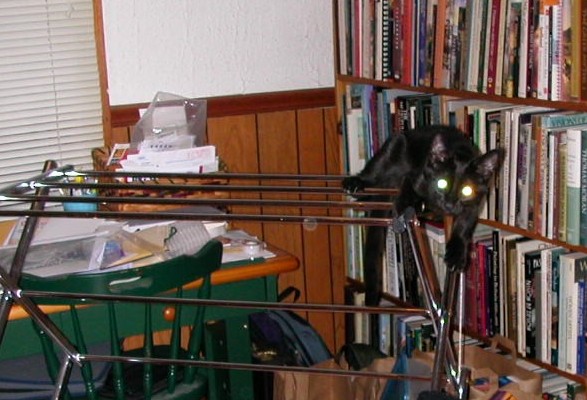
After a year, this is exactly what Luna has learned: nothing. Still doing the same damn thing, day in and day out.
A year ago:
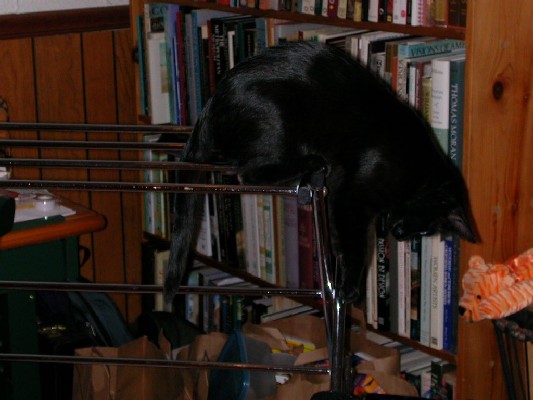
Now:
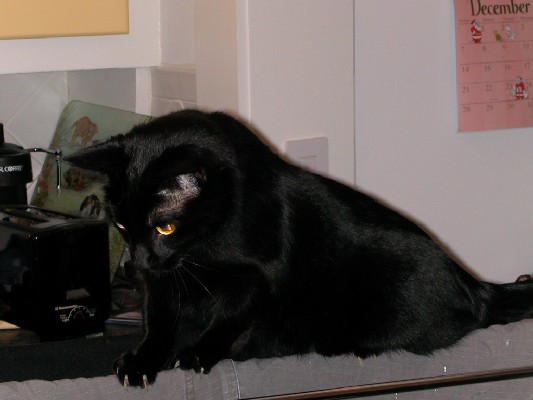
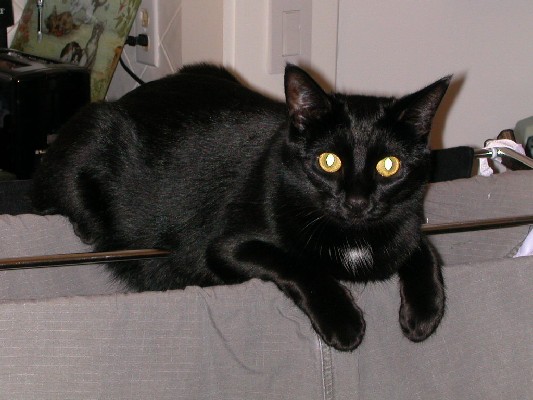
A year ago:
Now:
Tuesday, December 16, 2003
Today is my mom's birthday.
So, happy birthday, Mom, not that you read this, but still.
Last night was our last concert of the season, so I am free to be as lazy as I want in the evenings between now and January 12th. No more outside obligations, no more places I have to be no matter how lousy I feel, nothing between me and my recliner for the next three weeks. And once I get the rest of my Christmas packages sent on Thursday, I can come home from work and just sleep until I have to go to work the next day. Mmm..maybe I'll wake up around the 23rd and write some Christmas cards, hard to tell.
Courtesy of Alex: The Picture of Everything
Last night was our last concert of the season, so I am free to be as lazy as I want in the evenings between now and January 12th. No more outside obligations, no more places I have to be no matter how lousy I feel, nothing between me and my recliner for the next three weeks. And once I get the rest of my Christmas packages sent on Thursday, I can come home from work and just sleep until I have to go to work the next day. Mmm..maybe I'll wake up around the 23rd and write some Christmas cards, hard to tell.
Courtesy of Alex: The Picture of Everything
Saturday, December 13, 2003
Caught up with me.
I've been congested for weeks, feeling like I was fighting off a cold. But everyone at work is the same way, especially the dough makers, from breathing in so much flour. I don't get quite as much as they do, but I'm next in line for flour inhalation problems. After work, you just go home and try to blow out your nose and wish for clear lungs, then go back and start over again the next day. I've had a slow nosebleed for at least two weeks now, and I guess I'm blaming that on the job, too.
Anyway, I think the common cold is finally taking over. Surely flour can't make your ears itch or glands swell. Lucky for me, it's the weekend. I earned several spousal points today by dragging myself out into the cold to take Catherine to the Institute because the climate control alarm was going off. Probably I would have only earned one or two on an ordinary day, but since I'm obviously sick, I think I kicked it up to ten or eleven, so it's all good.
I'm not shoveling snow, though.
Anyway, I think the common cold is finally taking over. Surely flour can't make your ears itch or glands swell. Lucky for me, it's the weekend. I earned several spousal points today by dragging myself out into the cold to take Catherine to the Institute because the climate control alarm was going off. Probably I would have only earned one or two on an ordinary day, but since I'm obviously sick, I think I kicked it up to ten or eleven, so it's all good.
I'm not shoveling snow, though.
Friday, December 12, 2003
Graduating.
We had a nice time last night. Catherine turned in her last paper of graduate school yesterday, a day early. This is the first time in her entire life that she has ever finished a paper early--a lot of early tension in our relationship could be traced to her absolutely annoying habit of finishing research papers at 4 a.m. on the day they were due--and caught me by surprise. I had to run out and get the cake and champagne a day before I expected to need it.

Subscribe to:
Posts (Atom)


 Posts
Posts


